
-
 |
|
-

- FREE UK Exchanges
-
The Cost of Disconnection: Why Your Business Needs a Single Source of Truth

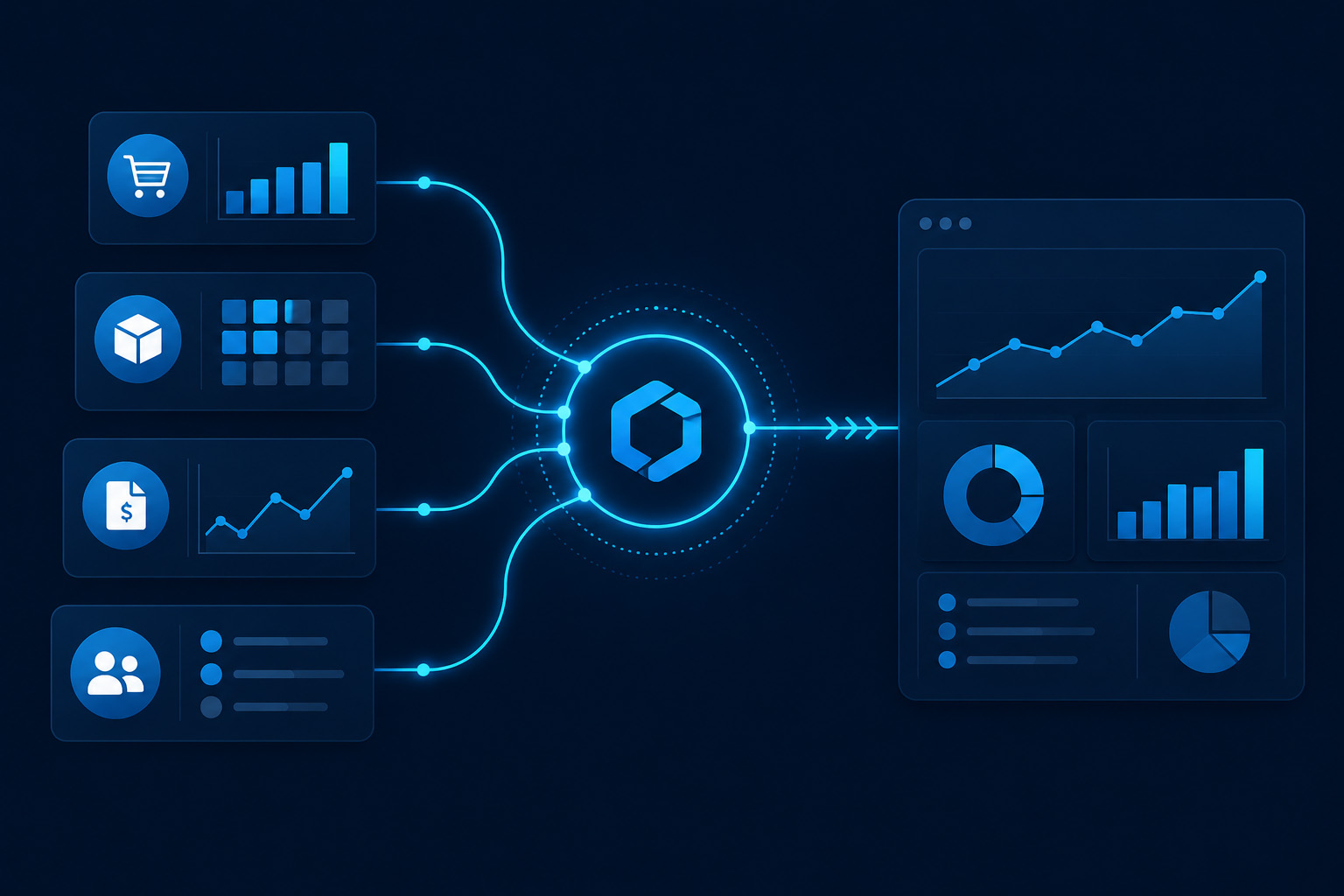
Ask any business owner how many systems they rely on to run their operation day-to-day. For most, the answer is somewhere between six and fifteen: a CRM here, a stock system there, a finance package, a few spreadsheets, an eCommerce platform, and a handful of manual processes holding it all together.
It works. Until it doesn’t.
The Hidden Cost of Disjointed Systems
Most businesses don’t realise how much disconnected tools are costing them, because the cost doesn’t show up as a single line on a report. It accumulates quietly: in the hours spent rekeying data from one platform to another, in the version conflicts when two people are working from different spreadsheets, in the customer-facing errors that happen when stock levels in one system don’t match what’s actually in the warehouse.
The real damage shows up in decisions. When your data lives in multiple places, nobody has the full picture. Finance sees one number. Operations sees another. The MD is working from last month’s export. Decisions get made on incomplete or stale information, and by the time anyone realises, the problem has already played out.
This isn’t a technology failure. It’s a structural one. And it happens in businesses of every size.

What a Single Source of Truth Actually Means
A single source of truth isn’t a buzzword. It’s a straightforward principle: one platform, one version of every record, with every team (sales, finance, warehouse, purchasing) working from the same data, updated in real time, without manual reconciliation.
When that’s in place, something shifts. You stop managing systems and start managing the business.
The four areas where it makes the biggest difference are:
- Sales and eCommerce: Orders, stock, and pricing stay synchronised across every channel automatically. No manual updates, no lag, no discrepancies between what your website shows and what’s actually available.
- Warehouse and Stock: A single, accurate stock position at all times. No more counting twice, no more discovering a fulfilment problem after a customer has already been promised a delivery date.
- Finance and Purchasing: Every order, invoice, and payment in one place. Reporting becomes instant and auditable, not something assembled from exports on a Friday afternoon.
- Customers and CRM: A complete view of every customer relationship, accessible to anyone who needs it. Sales history, communications, outstanding orders, all in one place rather than scattered across inboxes and spreadsheets.
Where Most Businesses Start
Moving to a unified platform doesn’t have to mean ripping everything out and starting over. The businesses that do it well tend to approach it as a structured journey:
- Audit your current systems. Map out what you’re actually running and where the overlaps are.
- Identify where data is being rekeyed. Those points are your biggest risk and your biggest opportunity.
- Find your most painful friction point. That’s usually where the return on investment from unification is clearest.
- Evaluate whether your current tools can grow with you, or whether they’re already holding you back.
- Think platform, not point solutions. The goal is fewer systems that do more, not more systems that each do one thing.
- Plan for adoption, not just implementation. The technology is the easier part. Getting your team working in a new way is where the real work is.
The Takeaway
Disjointed systems are rarely the result of bad decisions. They’re the result of a business growing faster than its infrastructure, with each tool solving one problem at a time, until suddenly there are too many tools and not enough visibility.
The businesses that scale well tend to be the ones that at some point make a deliberate decision: to stop adding tools and start consolidating them. To trade complexity for clarity. To give every team a single place to find the answer.
That’s what a unified platform delivers. Not just efficiency, though you’ll get that too. A clearer, more confident way of running the business.
Interested in exploring what a unified business platform could look like for your organisation? Get in touch with the Inforgen team.